
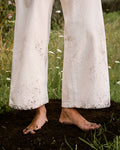




On soil, care, and learning to move at a natural pace
When did you first start noticing soil?
I first started really noticing soil when we were setting up gardens, then planting the olive grove on the farm and working directly with the whenua. Straight away, it was obvious that the soil was good quality — things grew well, easily, without much intervention.
Later, I learned that it was Class 1 or A-Grade soil, which is quite rare across Aotearoa. But I think I knew that long before seeing it on paper. The whenua showed you what it was capable of through how it behaved and how it supported what we planted.
How would you describe healthy soil?
Healthy soil feels alive. That’s the simplest way to put it. You can tell there’s activity happening beneath the surface.
Of course, there’s a technical side — the ratio of carbon and nitrogen, the presence of essential minerals, microbes, and biological life — but healthy soil is more than a checklist. When soil is working properly, plants don’t struggle. They’re supported from the ground up.
Once I understood the quality of the soil, the question shifted from what I can get from it to how I look after it properly.
Māori have a range of different values and principles for soil health. Enhancing the mana and mauri of soil as oneone, is all about re-emphasising our critical interrelationships and interdependencies as humans to ensure healthy soil. It’s a wairua or spiritual relationship to plants, trees and related biodiversity too. Over the last five years especially, I’ve spent a lot of time learning how to enhance what’s already there. That’s meant composting: food waste from my verified kitchen; straw and manure from the animal shed, and mulched pest weeds from the stream and wetlands for building soil slowly. This includes understanding how different practices support long-term soil health. It’s never about a single solution — it’s about consistency, patience, and letting systems build over time.

Why is biochar important for soil health?
Biochar is, in a way, a little magic. It’s part of the bigger picture of caring for soil over time. It supports soil structure, sequesters carbon, helps soil hold nutrients, and retain moisture for dry times.
For me, it sits alongside other practices like composting and building soil slowly. It’s about thinking long-term, not quick fixes. When we focus on nurturing the soil and letting natural systems develop at their own pace, biochar can play a helpful role in supporting that process.

Has working with soil influenced the way you think about time and pace?
Very much so. Working with soil is inherently slow, and it forces you to adjust to that.
You can’t rush growth. You can only create the conditions and then wait. That process has been incredibly grounding for me. It’s de-stressing, it’s meditative, and it changes how you relate to time more generally. Slow gardening has taught me to be present and patient in ways I didn’t expect.
How does nature show up in your everyday life?
Nature isn’t something I visit — it’s what my days are built around.
Most days when not on campus are spent outside, working within my organic/hua parakore gardens, orchards, trees, and soil. There’s a rhythm to it that feels natural. Being immersed in Te Taiao creates a sense of connection that’s hard to separate from daily life. It’s not dramatic or idealised; it’s just consistent and real.

How do you think about your relationship with the natural world more broadly?
From a Māori perspective, our environment is the source of all knowledge, and when we damage those relationships between us and Te Taiao, we damage ourselves.
There’s whakapapa there — an understanding that humans are kin with the natural world, not above it, nor dominating in any way. When you recognise that, it changes how you act. You become more aware of what you take, and more responsible for what you give back. This follows an ancestral tikanga for the correct ways to do things. That sense of reciprocity is essential to wellbeing, both personal and collective.

What does slow living look like for you in a practical sense?
Slow living, for me, is about intention rather than withdrawal.
I say no to more things now. I choose where to focus my energy and time, and I’ve reduced the constant movement between projects. That doesn’t mean doing less — it means doing things with more care and clarity. Spending more time on the farm has been a big part of that shift.

How do you know when something — a project, a phase, a season — is complete?
There’s usually a quiet moment of knowing. It’s like finishing an artwork — you reach a point where your hands come off and there’s nothing more to add.
After that comes reflection. You take stock of what’s been done, what you’ve learned, and then you move forward. Completion isn’t rushed; it’s acknowledged.
I don’t really see things as ending. They evolve.
Each project feeds into the next. The orchards, the forests, the Waikōkopu Stream restoration — all of that continues beyond any one person. We contribute what we can, then step aside and let someone else carry it forward. That sense of continuity makes endings feel less like stops and more like handovers.

Professor Huhana Smith, Artist and Research Professor at Toirauwhārangi/ College of Creative Arts at Massey University, Wellington, has spent the last 30 years with her whānaunga from Ngāti Tukorehe focussed on the revitalisation of ancestral coastal whenua, wetlands and Ōhau awa at Kuku, near Levin, whilst visualising with teams, required natural solutions that buffer against more frequent climate change impacts.
She's part of Te Waituhi ā Nuku: Drawing Ecologies, a collective of environmental artists and researchers using Biochar as both an artistic medium and regenerative tool for land and waterway revitalisation.


